
Reconstructive Urology in Bangalore
A narrowed urine passage or a blocked kidney drainage can make every trip to the toilet a struggle, and repeated dilatations often give only short relief. Reconstructive surgery repairs the problem at its root. Dr. Vishal Shet, M.Ch Urology, performs urethroplasty, buccal mucosa graft repair and pyeloplasty to restore normal urine flow.
- Reconstructive urology is a stated area of expertise
- Published research on buccal graft healing in urethral surgery
- Long-term repair, not just short-term relief
Book a Reconstructive Urology Consultation
Share a few details and the team will call you back.
What Is Reconstructive Urology?
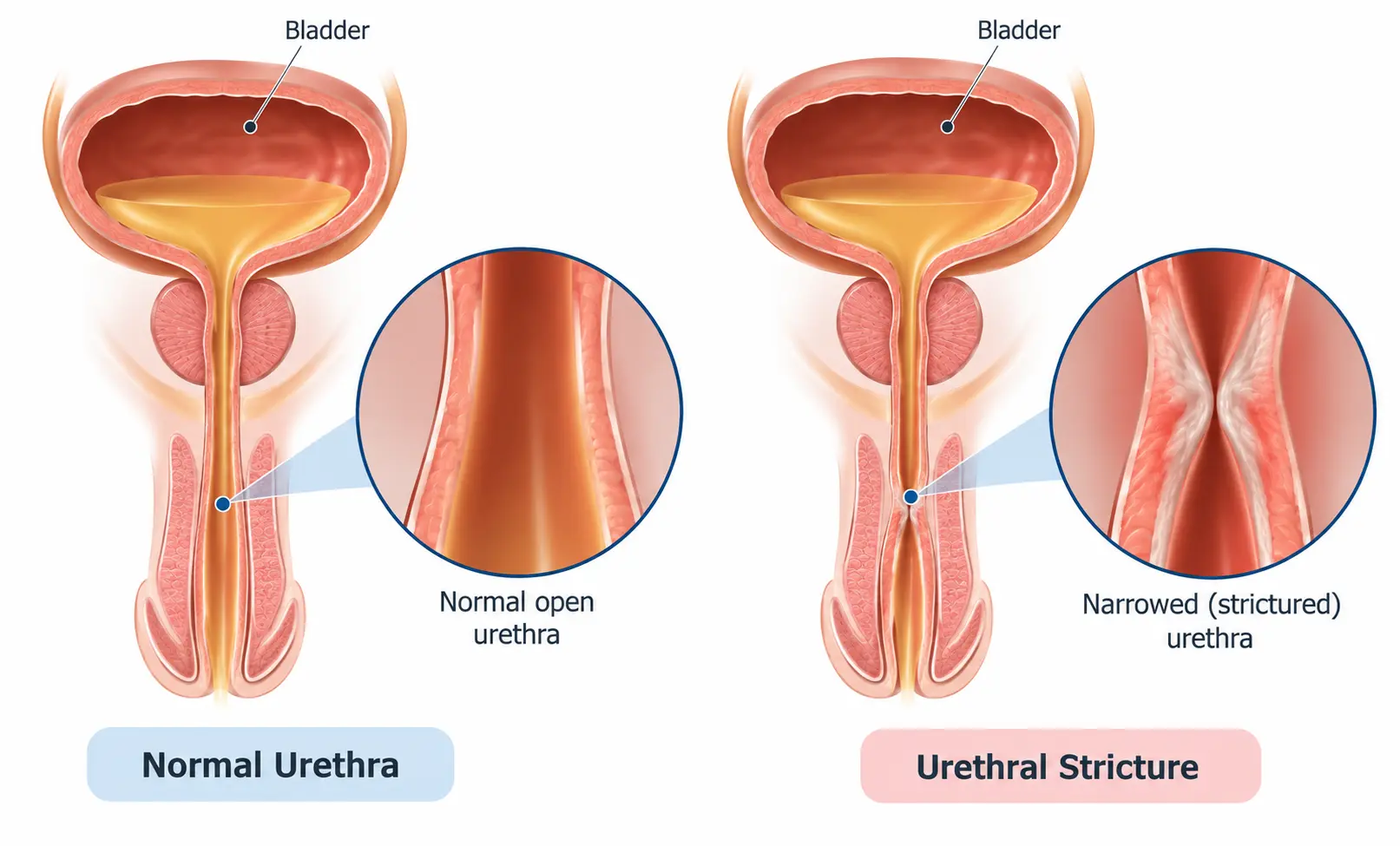
Reconstructive urology repairs parts of the urinary tract that have narrowed, been injured or did not form correctly. Instead of only stretching or bypassing the problem, it rebuilds the affected passage so urine can flow normally for the long term.
Stretching or cutting the scar
Dilatation or urethrotomy. Quick, but strictures often return.
Rebuilding the passage
Reconstructive surgery repairs the problem at its root for a lasting result.
Conditions Treated
Urethral stricture
What happens
Scar tissue narrows the urethra, the tube that carries urine out of the body
Who it affects
Mostly men; any adult age
PUJ obstruction
What happens
A narrowing where the kidney drains into the ureter, causing the kidney to swell
Who it affects
Children and adults; can be present from birth
Recurrent stricture after urethrotomy
What happens
A stricture that returns after one or more dilatations or cuts
Who it affects
Men who have had earlier procedures
Urethral injury
What happens
Damage to the urethra from a fall, accident or pelvic fracture
Who it affects
Men after trauma
Symptoms to Watch For
Urethral stricture
Narrowing of the urine passage- Thin, slow or spraying urine stream
- Straining or taking a long time to pass urine
- Feeling that the bladder is not empty
- Dribbling after passing urine
- Repeated urine infections
- Sudden inability to pass urine
PUJ obstruction
Blocked kidney drainage- Dull or sharp pain in the side, often after drinking a lot of fluid
- Kidney swelling (hydronephrosis) found on an ultrasound
- Repeated urine infections or kidney stones
- Sometimes no symptoms, found by chance on a scan
What Causes These Problems?
Urethral stricture
- 01Previous catheter use or scope procedures
- 02Injury to the groin, fall astride an object or pelvic fracture
- 03Infections of the urethra
- 04Inflammatory skin condition of the genitals (lichen sclerosus)
- 05No clear cause foundCommon
PUJ obstruction
- 01Narrowing present from birth
- 02A blood vessel crossing the kidney outlet
- 03Scarring after stones or earlier surgery
How These Conditions Are Diagnosed
The right repair depends on knowing exactly where the narrowing is and how long it is. Dr. Vishal advises the tests needed to map it accurately.
For urethral stricture
Uroflowmetry
Speed and pattern of the urine stream
Post-void residual ultrasound
Urine left in the bladder after passing urine
Retrograde urethrogram (RGU) and micturating urethrogram (MCU)
X-ray dye study showing the exact position and length of the stricture
Maps the strictureUrethroscopy
A thin camera to view the narrowing directly
For PUJ obstruction
Ultrasound
Kidney swelling (hydronephrosis)
CT urography
Detailed anatomy of the kidney and ureter, including crossing vessels
Renal scan (DTPA or EC)
How well each kidney works and whether drainage is truly blocked
Decides surgeryWhich Treatment Is Right for You?
Your plan depends on the length and position of the narrowing, earlier treatments and overall health. Pick what describes you to see the usual approach.
Optical internal urethrotomy (scope procedure) may be tried
Usually advised, as repeated urethrotomy has low long-term success
Excision and primary anastomosis urethroplasty
Buccal mucosa graft urethroplasty
Specialised urethroplasty after healing
Pyeloplasty
Monitoring with regular scans
Many patients go through repeated dilatations for years. If your stricture has come back even once, ask whether urethroplasty is a better long-term option.
Book a consultationReconstructive Procedures Offered
All procedures are done under anaesthesia. The goal is a lasting repair that lets you pass urine freely without repeated hospital visits.
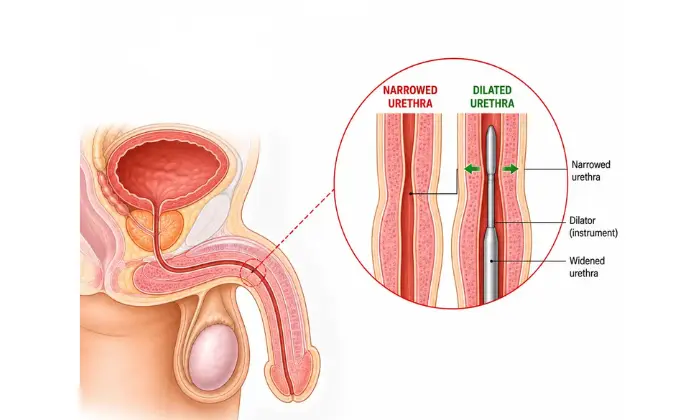
Urethral Dilatation and Optical Internal Urethrotomy
Scope procedure, no external cut
A thin scope is passed into the urethra and the scar is cut open from inside, with no external cut. It is quick, but strictures often return, so it suits only selected short, first-time strictures.
Learn about Urethral Stricture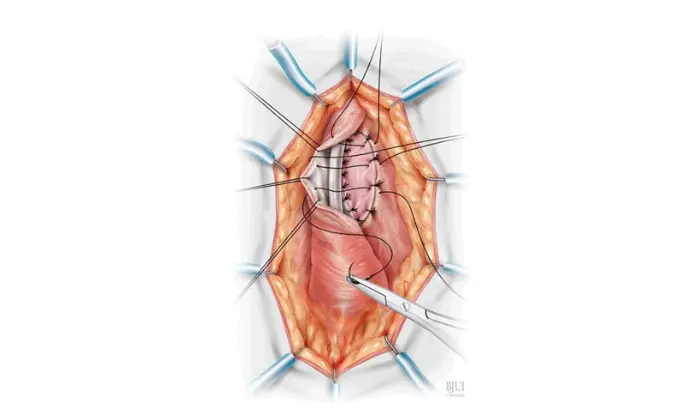
Urethroplasty
Excision and Primary Anastomosis
The scarred segment of the urethra is removed and the healthy ends are joined together. This gives a durable repair for short strictures.
Learn about Urethroplasty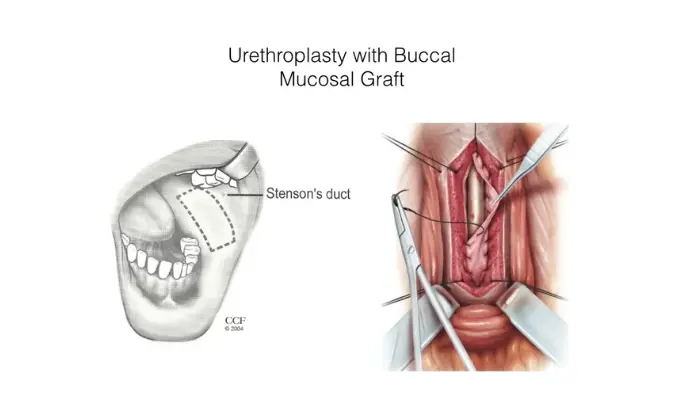
Buccal Mucosa Graft Urethroplasty
Cheek lining graft
A thin strip of lining from the inside of the cheek is used to widen the narrowed urethra. The cheek heals on its own within a few weeks. Dr. Vishal has published research on healing at the graft donor site.
Learn about Buccal Graft Urethroplasty
Pyeloplasty
Repair of PUJ obstruction
The narrowed junction between the kidney and ureter is removed and rejoined to create a wide opening, so urine drains freely from the kidney.
Detailed page coming soonHad a urethrotomy or dilatation that did not last? Book a consultation and bring your earlier reports.
Book a ConsultationWhy Choose Dr. Vishal for Reconstructive Urology

Reconstruction as a focus
Reconstructive urology is one of his stated areas of expertise, alongside open and endoscopic surgery.
Research on buccal grafts
His published study on buccal graft donor site healing informs how he harvests and closes the graft for a comfortable recovery.
Lasting repair over quick fixes
He discusses when urethroplasty is a better long-term option than repeated dilatations.
Careful mapping before surgery
Each stricture is studied with flow tests and dye X-rays so the right repair is chosen.
Patient-centred explanations
Patients describe a doctor who listens and explains every step clearly.
What Patients Say
They listened to all our concerns without rushing and explained the condition and treatment options clearly.
Got admitted under Dr. Vishal for a surgery. The doctor is very good and treated me very well.
Consultation with Dr. Vishal was good. The doctor listened with patience.
Recovery After Reconstructive Surgery
Hospital stay, catheter or stent, and time back to desk work for each procedure.
Optical internal urethrotomy
Urethroplasty (any type)
Buccal graft donor site (cheek)
Pyeloplasty
Protecting Your Urinary Tract
Not every stricture or blockage can be prevented, but these steps reduce risk and catch problems early.

Treat urine infections fully
Complete the antibiotic course and get repeated infections checked.
Avoid unnecessary catheters
If you need one, ask about the shortest safe duration.
Protect the groin during sports and work
Falls astride a beam, bicycle bar or wall are a common cause of urethral injury.
Get a thin stream checked early
A stricture is easier to repair before it becomes long or causes bladder damage.
Do not ignore kidney swelling on a scan
Even without pain, it needs follow-up to protect kidney function.
Keep follow-up visits after repair
Early signs of narrowing can be treated simply.
When to Seek Urgent Care
Go to the nearest emergency department or call the team right away if you have any of these signs.
Call 9986277942- Sudden inability to pass urine with a painful, swollen lower belly
- Fever with chills and side pain
- Bleeding from the urine passage after an injury to the groin or pelvis
After a pelvic or groin injury, do not let anyone force a catheter in if it does not pass easily. A urologist should assess first.
Where to Get Reconstructive Urology Care in Bangalore
Dr. Vishal provides evaluation and reconstructive surgery at four hospitals.


Frequently Asked Questions About Reconstructive Urology
Have a different question?
Send your question or earlier reports and the team will get back to you.
Ask on WhatsApp Call 9986277942A urethral stricture is a narrowing of the urethra caused by scar tissue. It slows or blocks the flow of urine, causing a thin stream, straining and incomplete emptying. Left untreated, it can lead to infections, bladder damage and urinary retention.
Urethroplasty offers a long-lasting repair for most strictures, far more durable than repeated dilatation or urethrotomy. Regular follow-up in the first year helps catch any early narrowing, which can usually be treated simply.
Urethrotomy is a quick scope procedure that may work for a short, first-time stricture, but strictures often return. Urethroplasty is a bigger operation with a much more lasting result, and is usually advised for long or recurrent strictures.
The lining inside the cheek (buccal mucosa) is naturally used to a moist environment, heals well and is hairless, which makes it ideal for widening the urethra. The cheek heals on its own, with soreness usually settling in 1 to 2 weeks.
The catheter is usually kept for about 2 to 3 weeks while the repair heals. Before removal, a dye X-ray may be done to confirm there is no leak. Most patients manage the catheter at home after discharge.
The surgery is done under anaesthesia, so there is no pain during it. Discomfort afterwards is controlled with medicines and eases within the first week. Most patients find the recovery easier than they expected.
PUJ (pelviureteric junction) obstruction is a narrowing where the kidney joins the ureter. Urine cannot drain freely, so the kidney swells (hydronephrosis). It can cause side pain, infections and stones, and over time can reduce kidney function.
No. Mild swelling with good kidney function and no symptoms is often monitored with scans. Pyeloplasty is advised when there is pain, infection, stones or a fall in kidney function on the renal scan.
Pyeloplasty is considered the standard treatment for PUJ obstruction and gives lasting drainage in most patients. Dr. Vishal will explain what to expect in your case, based on kidney function and anatomy.
Yes, urethroplasty and pyeloplasty are generally covered by health insurance in India, subject to policy terms. The hospital's insurance desk helps with cashless approval.
Stop Living with a Struggling Urine Flow
Repeated dilatations and temporary fixes are not your only option. Meet Dr. Vishal to find out whether a lasting reconstructive repair is right for you.