
Prostate Treatment in Bangalore
After 50, many men notice a slower urine stream, frequent night-time trips to the toilet or a feeling that the bladder never fully empties. These are often signs of an enlarged prostate, which is common and treatable. Dr. Vishal Shet, M.Ch Urology, finds the cause and offers the right care, from medicines to TURP surgery done without any external cut.
- PG thesis research on TURP for large prostates
- Medicines first, surgery only when needed
- 4.9 Google rating from patients
Book a Prostate Consultation
Share a few details and the team will call you back.
What Is the Prostate?
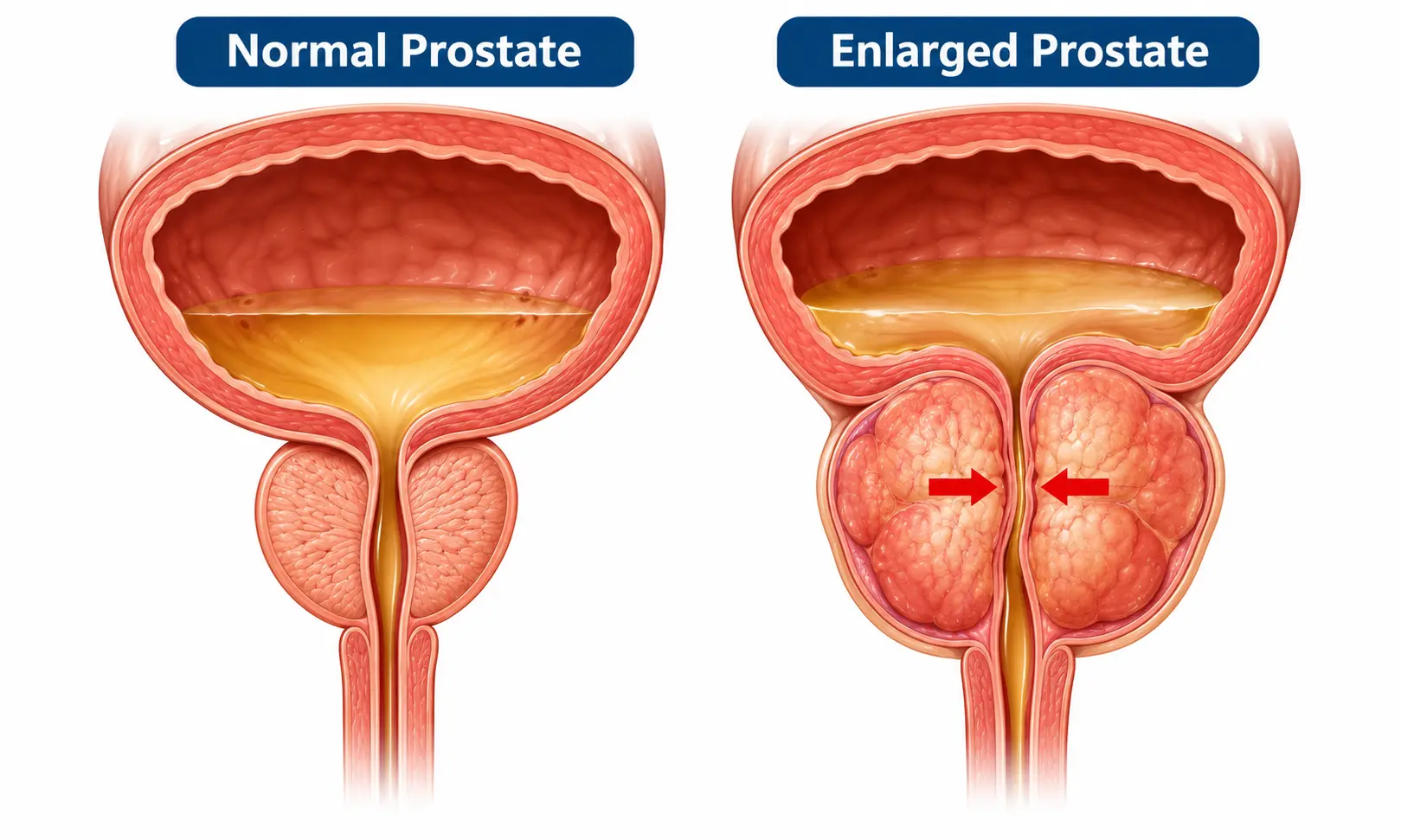
The prostate is a small, walnut-sized gland found only in men. It sits just below the bladder and wraps around the urethra, the tube that carries urine out of the body. Because of this position, any growth of the prostate can squeeze the urethra and affect how you pass urine.
Why prostate growth affects urine flow
Common Prostate Problems
Enlarged prostate (BPH)
Non-cancerous growth of the prostate with age.
Prostatitis
Inflammation or infection of the prostate.
Prostate cancer
Cancerous growth, often slow and silent in early stages.
Symptoms of Prostate Problems
Prostate symptoms fall into two groups. The third group needs prompt medical attention.
Trouble emptying the bladder
How the stream feels- Weak or slow urine stream
- Difficulty or delay in starting urination
- Straining to pass urine
- Stream that stops and starts
- Dribbling at the end
- Feeling that the bladder is not empty
Trouble storing urine
How often and how urgently- Needing to urinate often, especially at night
- Sudden, strong urge to urinate
- Leaking before reaching the toilet
Warning signs
See a urologist without delay- Blood in urine or semen
- Burning with fever and pain in the lower belly
- Sudden inability to pass urine
Who Is at Risk?
What Happens If Prostate Problems Are Ignored?
An untreated enlarged prostate can slowly weaken the bladder and lead to complications:
Acute urinary retention
Sudden, painful inability to pass urine that needs a catheter
Repeated urine infections
Leftover urine in the bladder allows bacteria to grow
Bladder stones
Stagnant urine forms stones inside the bladder. Bladder stone treatment
Bladder damage
The bladder muscle weakens from constant straining
Kidney damage
Back pressure of urine can affect kidney function over time
How Prostate Problems Are Diagnosed
Dr. Vishal starts with a detailed discussion of your symptoms, then advises tests to find the cause and measure how much the prostate is affecting your bladder.
Symptom score (IPSS)
A short questionnaire that rates how much symptoms affect daily life
Physical examination
Size, shape and texture of the prostate
Urine test
Infection or blood in urine
PSA blood test
A marker that helps screen for prostate cancer; also rises with enlargement or infection
Cancer screeningKidney function test
Whether back pressure has affected the kidneys
Ultrasound with post-void residual
Prostate size and how much urine stays in the bladder after passing urine
Uroflowmetry
Speed and pattern of the urine stream
MRI and prostate biopsy
To confirm the diagnosis
Only if cancer is suspectedWhich Treatment Is Right for You?
Treatment depends on how much the symptoms bother you, the prostate size, test results and your overall health. Pick what best describes you to see the usual approach.
Lifestyle changes and yearly review
Medicines to relax the prostate or shrink it over time
TURP surgery
TURP surgery is usually advised
TURP, including bipolar TURP, depending on size and health
Further tests and a cancer care plan if needed
Antibiotics and supportive treatment. About urine infections
Dr. Vishal's postgraduate research compared monopolar and bipolar TURP in prostates larger than 50 cc, the group where choosing the right technique matters most.
Read the studyProstate Treatments Offered
Most men with prostate symptoms improve with medicines. Surgery is advised when medicines stop working or complications appear, and it is done through the urine passage with no external cut.

Medicines for Enlarged Prostate
Medical treatment
Two main groups of medicines are used. One relaxes the prostate and bladder neck for quicker relief of flow; the other slowly shrinks the prostate over months. Some men need both.
Learn about Enlarged Prostate (BPH)
TURP Surgery
Transurethral Resection of the Prostate
A thin scope is passed through the urine passage, and the overgrown prostate tissue blocking the flow is removed in small pieces. There is no cut on the skin. Bipolar TURP uses saline and suits larger prostates.
Learn about TURP
Prostate Cancer Care
Evaluation and treatment planning
Evaluation with PSA, MRI and biopsy, followed by a treatment plan based on the stage and your health. Options can include active monitoring, surgery, hormone treatment or referral for radiation where needed.
Learn about Prostate Cancer Treatment
Bladder Stone Removal with Prostate Surgery
Treated in the same sitting
Bladder stones often form because an enlarged prostate stops the bladder from emptying. Both are usually treated in the same sitting.
Learn about Bladder Stone TreatmentNot sure whether you need medicines or surgery? Book a consultation and bring your ultrasound or PSA report.
Book a ConsultationWhy Choose Dr. Vishal for Prostate Care

Research in prostate surgery
His postgraduate thesis studied TURP techniques for large prostates over 50 cc.
Medicines before surgery
Surgery is advised only when medicines are not enough or complications appear.
No external cut
TURP is done entirely through the urine passage.
Cancer screening built in
PSA and examination are part of every evaluation, so cancer can be picked up early alongside enlargement.
Unhurried consultations
Patients say he listens with patience and explains every query clearly.
What Patients Say
Consultation with Dr. Vishal was good. The doctor listened with patience.
Nice consultation. He explains every patient query with a smile.
Dr. Vishal is excellent in diagnosis and provides good care. Highly recommended.
Recovery After TURP
What to expect at each stage, from the hospital stay to full healing.
Hospital stay
Usually 2 to 3 daysCatheter
1 to 3 daysA urine catheter while the area heals.
First 2 weeks
Settles graduallyMild burning, frequent urge and some blood in urine are common and settle gradually.
Back to desk work
Usually 1 to 2 weeksHeavy lifting, cycling, straining
Avoid for 4 to 6 weeksFull healing
About 6 to 8 weeksAn honest note on side effects
Many men notice that semen does not come out during climax after TURP (retrograde ejaculation). This is harmless to health but can affect fertility. Dr. Vishal discusses this and other possible effects before surgery.
Tips for Better Prostate Health
These habits ease urine symptoms and support overall prostate health.

Cut fluids 2 hours before bed
Fewer night-time trips to the toilet.
Limit tea, coffee and alcohol in the evening
They irritate the bladder and increase urgency.
Do not hold urine for long
Empty the bladder regularly, and try double voiding (pass urine, wait a minute, try again).
Stay active
Regular walking helps weight control and urine symptoms.
Manage diabetes and blood pressure
Both affect bladder function.
Check medicines
Some cold and allergy tablets can worsen urine flow; tell your doctor about them.
Get a check-up after 50
A yearly prostate review, with PSA when advised, helps catch problems early.
When to Seek Urgent Care
Go to the nearest emergency department or call the team right away if you have any of these signs.
Call 9986277942- Sudden inability to pass urine with a painful, swollen lower belly
- Heavy blood in urine or passing clots
- Fever with chills and pain while passing urine
Urinary retention is an emergency and needs a catheter to relieve the bladder without delay.
Where to Get Prostate Treatment in Bangalore
Dr. Vishal provides prostate consultation and TURP surgery at four hospitals.


Frequently Asked Questions About Prostate Problems
Have a different question?
Send your question or PSA report and the team will get back to you.
Ask on WhatsAppCall 9986277942No. An enlarged prostate (BPH) is a non-cancerous growth that comes with age, and it does not turn into cancer. Prostate cancer is a separate condition, but both can occur together and cause similar symptoms, so a PSA test and examination are advised.
Prostate growth usually begins after 40, and symptoms become common after 50. By 60, about half of men have some enlargement, though not all have symptoms that need treatment.
Yes. Most men with mild to moderate symptoms do well with medicines and lifestyle changes. Surgery is advised when medicines do not help or complications such as urinary retention, infections or bladder stones occur.
Surgery is usually advised when you cannot pass urine, have repeated urine infections, bladder stones, blood in urine from the prostate, kidney effects from back pressure, or symptoms that remain troublesome despite medicines.
No. TURP is done under spinal or general anaesthesia, so there is no pain during surgery. Afterwards, there is mild discomfort and burning for some days, which settles with medicines. There is no external cut.
Most men stay in hospital for 2 to 3 days and return to desk work in 1 to 2 weeks. Heavy lifting and straining should be avoided for about 4 to 6 weeks, and full healing takes 6 to 8 weeks.
Erections usually remain unaffected. Many men have retrograde ejaculation, where semen flows back into the bladder instead of coming out. It is harmless to health but may affect fertility, so it is discussed before surgery.
There is no single normal value for everyone. PSA naturally rises with age and prostate size, and can also rise with infection. A value is judged along with your age, examination and prostate size, so Dr. Vishal reviews it in full context.
PSA testing is a personal decision best made after discussing benefits and limits with a urologist. Men over 50, or over 45 with a family history of prostate cancer, should talk to a doctor about regular screening.
The cost depends on the hospital, room type, prostate size and insurance cover. Dr. Vishal's team shares an estimate after evaluation. TURP is generally covered under health insurance in India, and the hospital helps with cashless approval.
Don't Let Prostate Symptoms Disturb Your Sleep and Daily Life
Most prostate problems are easier to treat when caught early. Meet Dr. Vishal for a full evaluation and a clear plan, whether that means medicines, monitoring or surgery.