

Standing at the toilet for minutes, pushing out a thin, spraying stream, and still feeling the bladder is not empty. Many men with a urethral stricture live like this for years, going back again and again for dilatations that help only for a few weeks or months.
A urethral stricture is a narrowing of the urine passage caused by scar tissue. Short-term procedures can stretch or cut the scar, but it often returns. Urethroplasty, a reconstructive operation, repairs the narrowed segment itself and gives a far more lasting result.
This guide explains what causes a stricture, how it is mapped, when urethrotomy is enough and when urethroplasty is the better choice, and what recovery after buccal graft surgery is really like.
Quick answer: A urethral stricture is scar tissue narrowing the urine passage. A short, first-time stricture may be treated with urethrotomy, a quick scope procedure, but strictures often return. Urethroplasty, which removes or widens the scarred segment, often using a graft from inside the cheek, offers a long-lasting repair for long or recurrent strictures.
What Is a Urethral Stricture?
The urethra is the tube that carries urine from the bladder out of the body. In men, it is about 18 to 20 cm long and passes through the prostate, the area behind the scrotum and the penis. When this lining is injured or inflamed, it heals with scar tissue. As the scar contracts, the passage narrows.
| Part of the urethra | Where it is | Common causes of stricture |
|---|---|---|
| Penile urethra | Inside the penis | Catheters, scope procedures, skin conditions such as lichen sclerosus |
| Bulbar urethra | Behind the scrotum | The most common site; falls astride an object, no clear cause in many men |
| Posterior urethra | Near the prostate and pelvis | Pelvic fracture injuries, after prostate surgery |
Strictures are much more common in men. In women they are rare and treated differently.
What Causes a Urethral Stricture?
| Cause | Examples |
|---|---|
| No clear cause (idiopathic) | A large share of bulbar strictures |
| Medical procedures | Long-term or difficult catheter insertion, cystoscopy, TURP, other scope procedures |
| Injury | Falling astride a bicycle bar, wall or beam; pelvic fracture in road accidents |
| Infection | Past urethral infections, including sexually transmitted infections |
| Lichen sclerosus | A chronic skin condition affecting the tip of the penis and the urethra |
| Previous hypospadias surgery | Scarring after childhood repair |
Symptoms of a Urethral Stricture
- A thin, slow or spraying urine stream
- Straining or taking a long time to pass urine
- A feeling that the bladder is not empty
- Dribbling after passing urine
- Passing urine often, including at night
- Repeated urine infections or prostate infections
- Blood in urine or pain while passing urine
- Sudden inability to pass urine (urinary retention)
Good to know: A weak stream in an older man is often blamed on the prostate. In a younger man, or after a catheter, injury or earlier urethral surgery, a stricture is a common cause and needs to be ruled out.
How a Stricture Is Diagnosed and Mapped
Choosing the right repair depends on knowing exactly where the stricture is, how long it is and how many narrow areas there are.
| Test | What it shows |
|---|---|
| Uroflowmetry | Speed and pattern of the urine stream; a flat, slow curve is typical |
| Post-void residual ultrasound | Urine left in the bladder after passing urine |
| Retrograde urethrogram (RGU) | Dye injected from the tip shows the position and length of the stricture on X-ray |
| Micturating cystourethrogram (MCU) | Dye from the bladder side shows the urethra above the stricture |
| Urethroscopy | A thin camera views the narrowing directly |
| Urine culture | Infection, treated before surgery |
Treatment Options at a Glance
| Situation | Usual approach |
|---|---|
| Short, first-time bulbar stricture | Optical internal urethrotomy may be tried |
| Stricture that returned after urethrotomy or dilatation | Urethroplasty is usually advised |
| Short bulbar stricture (often up to 2 to 3 cm) | Excision and primary anastomosis urethroplasty |
| Longer bulbar or penile stricture | Buccal mucosa graft urethroplasty |
| Stricture with lichen sclerosus or very complex scarring | Buccal graft repair, sometimes in two stages |
| Stricture after pelvic fracture | Anastomotic urethroplasty, usually 3 months or more after the injury |
| Elderly or unfit for major surgery | Regular self-dilatation or a simpler procedure |
Urethral Dilatation and Urethrotomy
Dilatation gently stretches the narrowed area using graded instruments. It gives temporary relief but rarely cures a stricture.
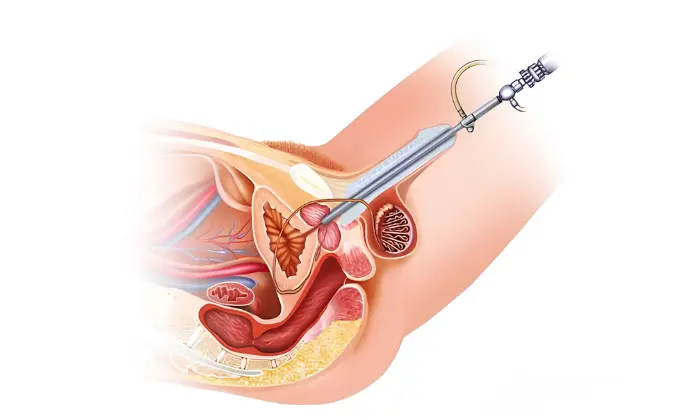
Optical internal urethrotomy (OIU) uses a scope passed into the urethra. The scar is cut open from inside with a fine blade or laser, with no external cut. A catheter is left for a few days.
| Feature | Urethrotomy |
|---|---|
| Suited for | Short, first-time strictures in the bulbar urethra |
| Hospital stay | Usually 1 day |
| Catheter | A few days |
| Long-term success | Many strictures return, especially longer ones |
| After a failed urethrotomy | Repeating it has a much lower chance of lasting success |
The urethrotomy trap: Many men undergo urethrotomy after urethrotomy for years. Each repeat procedure tends to lengthen the scar and makes later repair more complex. If a stricture has returned even once, it is worth asking whether urethroplasty is the better long-term option.
What Is Urethroplasty?
Urethroplasty is an open reconstructive operation that repairs the urethra directly. It is done through a cut behind the scrotum (perineum) or on the underside of the penis, depending on where the stricture is.
| Type of urethroplasty | How it works | Suited for |
|---|---|---|
| Excision and primary anastomosis (EPA) | The scarred segment is cut out and the healthy ends are joined | Short bulbar strictures, injury strictures |
| Buccal mucosa graft (BMG) onlay | The narrowed segment is opened and widened with a patch from the inner cheek | Longer strictures in the bulbar and penile urethra |
| Staged urethroplasty | Repair done in two operations a few months apart | Very complex strictures, lichen sclerosus, failed earlier repairs |
| Anastomotic repair after pelvic fracture | Scar from the injury is removed and the urethra rejoined | Posterior strictures after accidents |
Why Buccal Mucosa (Cheek Lining) Is Used
The lining inside the cheek is an excellent tissue for rebuilding the urethra because it:
- Is used to a constantly moist environment
- Is thick, tough and easy to handle
- Has a rich blood supply that helps the graft take
- Is hairless
- Leaves no visible scar, as the cheek heals from inside
A strip, usually 2 to 3 cm wide and as long as needed, is taken from one or both cheeks at the start of the operation.
Dr. Vishal’s Research on Buccal Graft Healing
Comfort at the cheek after graft harvesting matters a great deal to patients, because it affects eating and speaking in the first days after surgery. Dr. Vishal co-authored a study that looked at donor site morbidity, the pain and problems at the cheek after harvesting, and whether closing the donor site with stitches or leaving it open affects recovery.
Reference: Philipraj SJ, David D, Shet V. To close or not to close? Donor site morbidity after buccal mucosal graft harvesting. World Journal of Pharmacy and Pharmaceutical Sciences, 2017, Vol 6, Issue 9. DOI: 10.20959/wjpps20179-10041
How to Prepare for Urethroplasty
| Before surgery | Why |
|---|---|
| RGU and MCU, and urethroscopy if needed | Maps the stricture to plan the repair |
| Urine culture | Infection is treated first |
| Blood tests | Fitness for anaesthesia |
| No urethral instruments for some weeks before surgery | Lets the scar settle so its true length can be seen; a suprapubic catheter may be used if needed |
| Mouth check | Healthy cheek lining for graft; tobacco chewing or mouth disease is assessed |
| Stop tobacco | Improves graft healing |
| Fasting | Usually 6 to 8 hours before surgery |
Recovery After Urethroplasty
| Timeline | What to expect |
|---|---|
| Days 1 to 2 | Mild pain at the wound and cheek; soft diet; walking with support |
| Days 3 to 5 | Discharge for most patients with a urine catheter |
| Cheek, weeks 1 to 2 | Soreness and tightness ease; salt-water rinses help healing |
| Weeks 2 to 3 | Catheter removed, often after a dye X-ray around the catheter confirms no leak |
| Weeks 2 to 3 | Return to desk work |
| Weeks 4 to 6 | Avoid cycling, two-wheeler riding, heavy lifting and sexual activity until cleared |
| 3 months | Flow test and review |
Tips for a Smooth Recovery
- Keep the catheter bag below bladder level and the catheter clean
- Drink plenty of water and avoid constipation
- Eat a soft diet and rinse the mouth with warm salt water after meals while the cheek heals
- Avoid sitting on hard surfaces for long, and avoid cycling until cleared
- Keep every follow-up visit, especially the first year of flow tests
Call your doctor if you have: fever, a blocked or dislodged catheter, swelling or discharge from the wound, heavy bleeding, or pain not controlled by medicines.
Risks of Urethroplasty
| Possible effect | Notes |
|---|---|
| Return of the stricture | Less common than after urethrotomy; often treatable with a minor procedure if caught early |
| Urine leak at the repair | Usually heals with a longer catheter time |
| Wound infection | Treated with antibiotics |
| Cheek discomfort or tightness | Usually settles in a few weeks; long-term problems are uncommon |
| Change in penile sensation or shape | Uncommon; discussed before surgery |
| Erection changes | Uncommon, more relevant after pelvic fracture repairs |
| Post-void dribbling | Can occur; improves with pressing behind the scrotum after urinating |
Follow-Up After Stricture Treatment
| Time after surgery | Usual check |
|---|---|
| 3 months | Uroflowmetry and symptom review |
| 6 and 12 months | Flow tests; urethroscopy if the flow drops |
| Yearly | Flow test and symptom review |
“They listened to all our concerns without rushing and explained the condition and treatment options clearly.”
Amrutha P., Google review
Frequently Asked Questions About Urethral Stricture
Can a urethral stricture go away on its own?
No. A stricture is scar tissue, which does not disappear. Without treatment, it usually stays the same or slowly gets worse, and can lead to infections, bladder damage and retention.
Is urethrotomy enough for a stricture?
For a short, first-time stricture, urethrotomy may give lasting relief in some men. Many strictures return, and repeating urethrotomy has a much lower chance of success. Urethroplasty is usually advised after a recurrence.
What is the success rate of urethroplasty?
Urethroplasty gives a long-lasting repair in most men, with much better results than repeated urethrotomy. The expected outcome depends on the stricture’s length, position and cause, which Dr. Vishal will explain for your case.
Will taking cheek tissue affect eating or speaking?
Most patients have soreness and some tightness in the cheek for 1 to 2 weeks and eat a soft diet during this time. Long-term problems with eating, speaking or mouth opening are uncommon.
How long will I have a catheter after urethroplasty?
Usually about 2 to 3 weeks. A dye X-ray may be done before removal to make sure the repair has healed.
Can a stricture come back after urethroplasty?
It can, but much less often than after urethrotomy. Regular flow tests in the first year help catch any early narrowing, which can usually be treated simply.
Does urethroplasty affect sexual function?
Most men notice no lasting change in erections. Some notice minor changes in sensation or ejaculation. These are discussed in detail before surgery.
Is urethroplasty covered by insurance?
Yes, urethroplasty is generally covered by health insurance in India, subject to policy terms. The hospital’s insurance desk helps with cashless approval.
The Bottom Line
A urethral stricture does not have to mean a lifetime of repeated dilatations. Urethrotomy has a place for short, first-time strictures, but when a stricture returns, urethroplasty offers a far more durable repair. Careful mapping of the stricture and a repair matched to its length and cause are what make the difference.
If you have a narrowed urine passage, or a stricture that keeps coming back, Dr. Vishal Shet can review your reports and explain whether urethrotomy or urethroplasty is right for you. Consultations are available at Aveksha Hospital (MS Palya), Gurushree Hospital (Chandra Layout), Fortis Hospital (Nagarbhavi) and Hosmat Hospital (Magrath Road).
Related reading: Reconstructive Urology in Bangalore | Prostate Treatment in Bangalore | TURP Surgery
Medically reviewed by Dr. Vishal Shet, MBBS, MS (General Surgery), M.Ch (Urology) · Karnataka Medical Council Reg. No. 83367 · Last reviewed: November 2026. For general patient education; read our Editorial Policy and Medical Disclaimer.