
Kidney Stone Treatment in Bangalore
A kidney stone can cause pain severe enough to stop your day, and some stones block urine flow or lead to infection. Dr. Vishal Shet, M.Ch Urology, treats kidney, ureter and bladder stones with laser and keyhole procedures such as RIRS, URSL and PCNL, matched to the size and position of your stone.
- No-cut laser options for most stones
- Published research on RIRS vs Mini PCNL
- 4.9 Google rating, with stone patients among the reviews

What Are Kidney Stones?
Kidney stones (renal calculi) are hard deposits of minerals and salts that form inside the kidney when urine becomes too concentrated. They can stay in the kidney without symptoms or move into the ureter, the narrow tube that carries urine to the bladder. When a stone gets stuck in the ureter, it blocks urine flow and causes sudden, intense pain.
Stones range from the size of a grain of sand to larger than a marble. Their size and position decide whether they can pass on their own or need treatment.
From a grain of sand to larger than a marble
Symptoms of Kidney Stones
If you notice one or more of these, a urologist can confirm whether a stone is the cause.
What Causes Kidney Stones?
Stones form when substances such as calcium, oxalate and uric acid build up faster than urine can dilute them. Common risk factors:
Low water intake
Concentrated urine lets crystals form and stick together.
High salt diet
Raises the calcium in urine.
High intake of animal protein
Increases uric acid and lowers protective citrate.
Family or past history
About half of people who form one stone form another.
Obesity, diabetes, high blood pressure
Linked to changes in urine chemistry.
Certain medical conditions
Gout, recurrent urine infections, bowel disease, overactive parathyroid gland.
Hot weather and heavy sweating
Fluid loss without enough replacement.
Types of Kidney Stones
Calcium oxalate
Usual cause
Low fluids, high oxalate or salt in diet, metabolic factors
Calcium phosphate
Usual cause
Metabolic or kidney conditions
Uric acid
Usual cause
Acidic urine, high purine intake
Struvite
Usual cause
Recurrent urine infections; can grow large quickly
Cystine
Usual cause
Inherited condition
How Kidney Stones Are Diagnosed
Dr. Vishal starts with your symptoms and an examination, then advises only the tests needed to plan treatment.
Urine routine and culture
Blood, crystals or infection in urine
Blood tests
Kidney function, calcium and uric acid levels
Ultrasound (KUB)
Stones in the kidney and swelling from blockage (hydronephrosis)
No radiationPlain CT scan (NCCT KUB)
Exact size, position and density of the stone
Most accurate testX-ray KUB
Tracks some stones over time
Stone analysis
Stone type after removal, to guide prevention
Which Treatment Is Right for Your Stone?
The right treatment depends on the stone's size, position, hardness, your kidney anatomy and overall health. Pick where your stone is to see the usual approach.
Fluids and pain relief; most pass in a few weeks
Medicines that relax the ureter to help it pass; URSL if it does not pass or pain persists
URSL with laser
No-cut laser
Chosen on stone hardness and position
Through a small keyhole in the back
Endoscopic removal or PCCLT
Open or combined surgery such as pyelolithotomy, in selected cases
Dr. Vishal's published study compared RIRS and Mini PCNL for 1 to 2 cm kidney stones, the size range where choosing the right option matters most.
Read the studyKidney Stone Procedures Offered
Every procedure below is done under anaesthesia, so you feel no pain during surgery. Most use the natural urine passage or a small keyhole instead of a large cut.

RIRS
Retrograde Intrarenal Surgery
A thin, flexible scope goes up the urine passage into the kidney, and a laser breaks the stone into fine dust. No cut on the skin.
Learn about RIRS
URSL
Ureteroscopic Lithotripsy
A slim scope reaches the stone stuck in the ureter, and a laser breaks it so the pieces can be removed or passed. No cut on the skin.
Learn about URSL
PCNL and Mini PCNL
Percutaneous Nephrolithotomy
A small keyhole is made in the back to reach the kidney directly. Large stones are broken and removed in one sitting in most cases. Mini PCNL uses an even smaller tract.
Learn about PCNL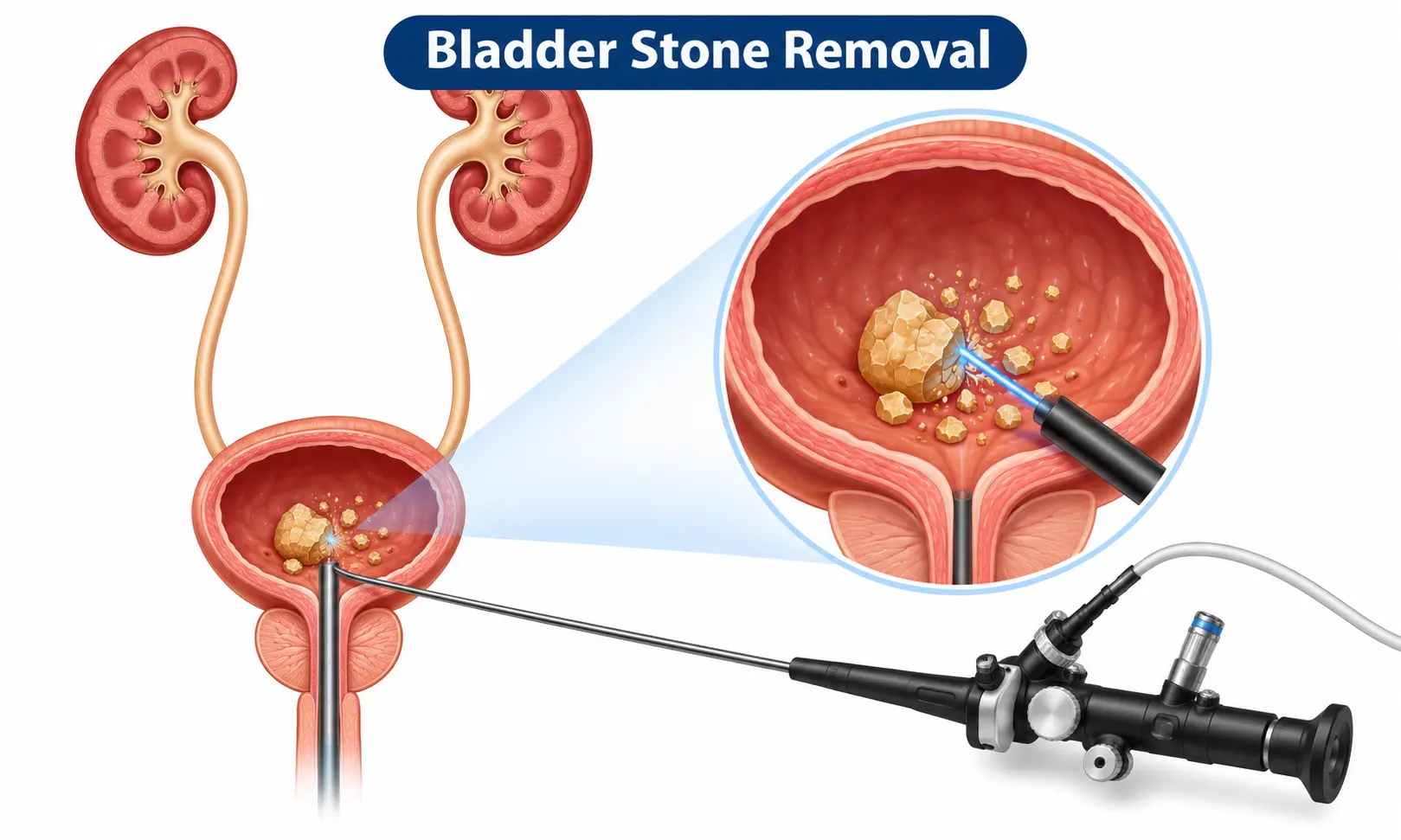
Bladder Stone Removal
PCCLT and Endoscopic
Bladder stones are broken through a scope passed into the bladder, or through a small puncture above the pubic bone for large stones (PCCLT).
Learn about Bladder Stone TreatmentOpen Stone Surgery
Pyelolithotomy
Used for very complex stones or when the kidney's drainage also needs surgical correction.

About the DJ stent
After RIRS or URSL, a small temporary tube called a DJ stent is often placed to help the kidney drain. It is removed in a short day-care procedure, usually within 1 to 3 weeks.
Not sure which procedure suits you? Send your scan report on WhatsApp for a review.
WhatsApp Your ReportWhy Choose Dr. Vishal for Kidney Stone Treatment

Trained in endourology
M.Ch Urology with hands-on training in RIRS, URSL, PCNL and PCCLT.
Evidence-based choice
Published research comparing RIRS and Mini PCNL guides which option he recommends for your stone.
No-cut options first
Laser and scope procedures are preferred wherever they suit the stone.
Clear explanation
You see your scan, understand your stone and know every option before deciding.
Prevention plan
Stone analysis and diet advice to lower the chance of new stones.
What Patients Say
Reviews from kidney stone patients and their families.
They listened to all our concerns without rushing and explained the condition and treatment options clearly.
My husband underwent RIRS under Dr. Vishal. The surgery went well.
Got admitted under Dr. Vishal for kidney stone removal. He treated me very well.
Wonderful consultation and good experience with the doctor and staff.
Recovery After Kidney Stone Surgery
Typical hospital stay and time back to desk work for each procedure.
RIRS
Mild burning or pink urine for a few days is common
URSL
Stent discomfort settles after removal
PCNL / Mini PCNL
Small dressing on the back; avoid heavy lifting for a few weeks
Bladder stone removal
Usually combined with prostate care if needed
How to Prevent Kidney Stones
Stones often come back, but simple daily habits lower the risk significantly.

Drink enough water
Aim for about 2.5 to 3 litres a day, more in hot weather or after exercise, so urine stays pale yellow.
Cut down on salt
Limit pickles, papads, chips and packaged foods.
Moderate animal protein
Large amounts of meat, fish and eggs raise stone risk.
Do not stop calcium
Normal dietary calcium from milk and curd actually helps prevent oxalate stones.
Add citrus
Lemon water and citrus fruits raise citrate, which protects against stones.
Limit high-oxalate foods if advised
Such as spinach, beetroot and nuts, based on your stone type.
Keep a healthy weight
And manage diabetes and blood pressure.
When to Seek Urgent Care
Go to the nearest emergency department or call the team right away if you have any of these signs.
Call 9986277942- Fever with chills along with stone pain
- Pain so severe you cannot sit still, or pain with constant vomiting
- Inability to pass urine
- A known stone in a single kidney, or during pregnancy
A blocked, infected kidney is an emergency and needs drainage without delay.
Where to Get Kidney Stone Treatment in Bangalore
Dr. Vishal performs kidney stone procedures at four hospitals. Choose the one closest to you.


Frequently Asked Questions About Kidney Stones
Have a different question?
Send your question or scan report and the team will get back to you.
Ask on WhatsAppCall 9986277942Stones under 5 mm usually pass on their own. Stones of 5 to 10 mm may pass with medicines but often need treatment. Stones over 10 mm, and any stone causing blockage, infection or repeated pain, usually need a procedure such as URSL, RIRS or PCNL.
Yes, small stones often pass with plenty of water, pain relief and medicines that relax the ureter. This can take a few days to a few weeks. If the stone does not move, pain persists or fever develops, it should be removed.
No. RIRS and URSL are done under anaesthesia, so you feel nothing during the procedure. Afterwards, mild burning while passing urine or slight discomfort from the stent is common and is managed with medicines.
Neither is better for everyone. RIRS needs no cut and suits stones up to about 2 cm. PCNL clears larger or harder stones more completely in one sitting. For 1 to 2 cm stones, the choice depends on stone hardness, position and kidney anatomy.
Most patients return to desk work 2 to 3 days after RIRS or URSL. After PCNL, return to normal activity usually takes 1 to 2 weeks. Heavy lifting should be avoided until Dr. Vishal advises otherwise.
A DJ stent is a thin, soft tube placed between the kidney and bladder after some stone procedures. It keeps urine draining while swelling settles. It is removed through a short day-care procedure, usually within 1 to 3 weeks.
Yes. About half of people who have had one stone form another within 10 years. Drinking enough water, reducing salt and following diet advice based on your stone type significantly lower this risk.
The cost depends on the procedure, stone size, hospital, room type and insurance cover. Dr. Vishal's team shares an estimate after reviewing your scan. Most procedures are covered under health insurance.
Yes, kidney stone procedures such as RIRS, URSL and PCNL are generally covered by health insurance in India. The hospital's insurance desk helps with cashless approval.
A stone that blocks urine flow can cause kidney swelling, infection and, over time, loss of kidney function. Even painless stones should be monitored by a urologist.
Get Your Kidney Stone Treated the Right Way
Share your ultrasound or CT report and Dr. Vishal will advise whether your stone can pass on its own or needs a procedure, and which one suits you.