
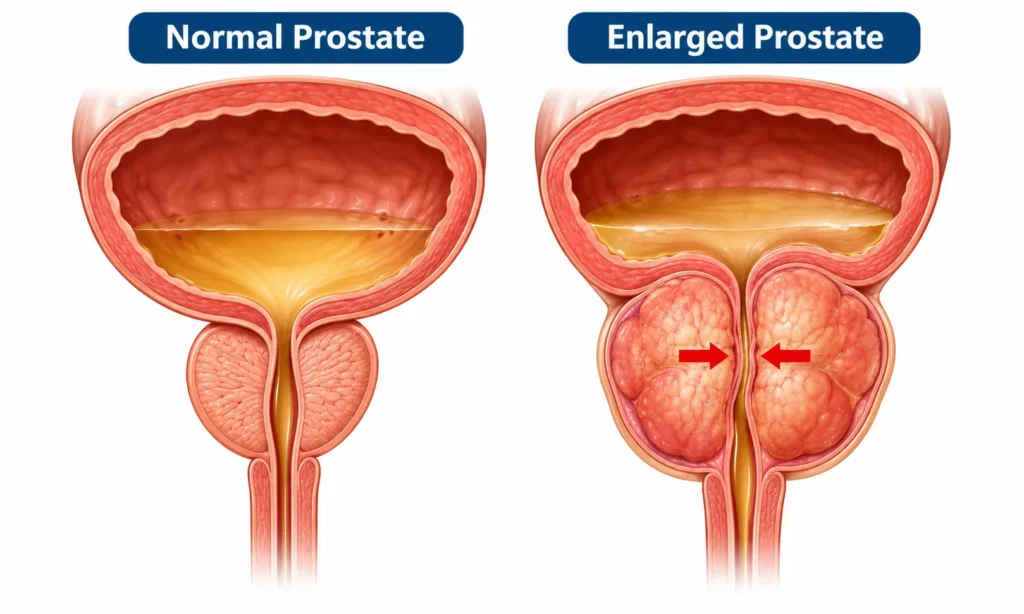

It often starts quietly. You wake up once at night to pass urine, then twice, then three times. The stream feels weaker than before, you stand longer at the toilet, and you leave feeling the bladder is still not empty. Many men accept this as “just age”.
In most cases, the cause is an enlarged prostate, also called BPH (benign prostatic hyperplasia). It is very common, it is not cancer, and it is treatable. The right treatment can give you back uninterrupted sleep and a normal stream, often with medicines alone.
This guide explains what BPH is, how to tell how serious your symptoms are, which medicines help, and when surgery becomes the better option.
Quick answer: BPH is a non-cancerous enlargement of the prostate that squeezes the urine passage. Mild symptoms can be watched with lifestyle changes, moderate symptoms usually improve with medicines, and surgery such as TURP is advised when medicines stop working or complications like urinary retention, bladder stones or repeated infections appear.
What Is BPH?
The prostate is a walnut-sized gland that sits just below the bladder and wraps around the urethra. From around the age of 40, it slowly starts to grow under the influence of male hormones. As it grows, it can narrow the urethra and press on the bladder outlet.
| Word | Meaning |
|---|---|
| Benign | Not cancer |
| Prostatic | Of the prostate gland |
| Hyperplasia | Increase in the number of cells, causing enlargement |
BPH is extremely common. About half of men in their 60s have some prostate enlargement, and the number rises with each decade. Not every man with an enlarged prostate has symptoms, and prostate size does not always match how bad the symptoms are.
Good to know: BPH does not turn into prostate cancer. However, both can be present at the same time and cause similar symptoms, so every man with urine symptoms should have a proper evaluation, including a PSA test when advised.
Symptoms of an Enlarged Prostate
Doctors group BPH symptoms into two types.
| Trouble emptying (voiding symptoms) | Trouble storing (storage symptoms) |
|---|---|
| Weak or slow stream | Passing urine often during the day |
| Delay before urine starts | Waking up at night to urinate (nocturia) |
| Straining to pass urine | Sudden, strong urge to urinate |
| Stream that stops and starts | Leaking before reaching the toilet |
| Dribbling at the end | |
| Feeling the bladder is not empty |
How Serious Are Your Symptoms?
Urologists use the International Prostate Symptom Score (IPSS), a short questionnaire of 7 questions about your urine symptoms over the past month, plus one question on quality of life.
| IPSS score | Severity | Usual approach |
|---|---|---|
| 0 to 7 | Mild | Watchful waiting and lifestyle changes |
| 8 to 19 | Moderate | Medicines, with regular review |
| 20 to 35 | Severe | Medicines or surgery, depending on tests and preference |
The score is filled in at your consultation and repeated during follow-up to see whether treatment is working.
When an Enlarged Prostate Becomes Serious
Left untreated for years, BPH can lead to complications that need prompt treatment.
| Complication | What it means |
|---|---|
| Acute urinary retention | Sudden, painful inability to pass urine; needs a catheter |
| Chronic retention | The bladder never empties fully and slowly stretches |
| Repeated urine infections | Leftover urine lets bacteria grow |
| Bladder stones | Stagnant urine forms stones inside the bladder |
| Blood in urine | Fragile prostate blood vessels can bleed |
| Kidney damage | Back pressure of urine can affect kidney function |
Important: Some cold and allergy tablets, especially those containing decongestants or antihistamines, can suddenly worsen urine flow in men with BPH and trigger retention. Check with your doctor before taking them.
How BPH Is Diagnosed
| Test | What it shows |
|---|---|
| IPSS questionnaire | Severity of symptoms and impact on daily life |
| Physical examination | Size, shape and texture of the prostate |
| Urine test | Infection or blood in urine |
| PSA blood test | Screens for prostate cancer; also rises with prostate size |
| Kidney function test | Whether back pressure has affected the kidneys |
| Ultrasound with post-void residual | Prostate size in cc and urine left after passing urine |
| Uroflowmetry | Speed of the urine stream |
| Frequency volume chart | A 2 to 3 day diary of fluid intake and urine output, useful for night-time symptoms |
Treatment Options for BPH
Treatment is chosen based on how much the symptoms bother you, the prostate size, test results and any complications.
| Option | Who it suits |
|---|---|
| Watchful waiting and lifestyle changes | Mild symptoms that do not affect daily life |
| Medicines | Moderate to severe symptoms without complications |
| Surgery (TURP and other procedures) | Symptoms not controlled by medicines, or complications |
Lifestyle Changes That Help
- Reduce fluids in the 2 hours before bed
- Limit tea, coffee and alcohol, especially in the evening
- Pass urine before going to bed and before long journeys
- Try double voiding: pass urine, wait a minute, then try again
- Avoid constipation, which can worsen urine symptoms
- Stay active and keep a healthy weight
- Review medicines that worsen urine flow with your doctor
Medicines for an Enlarged Prostate
| Medicine group | Examples | How it works | When it helps | Possible side effects |
|---|---|---|---|---|
| Alpha blockers | Tamsulosin, silodosin, alfuzosin | Relax the muscle of the prostate and bladder neck | Within days | Dizziness on standing, reduced or no semen at climax |
| 5-alpha reductase inhibitors | Finasteride, dutasteride | Shrink the prostate slowly | Over 6 to 12 months | Reduced sex drive, erection problems in some men |
| Combination therapy | Alpha blocker with a 5-ARI | Quick relief plus long-term shrinkage | Larger prostates | Side effects of both groups |
| PDE5 inhibitor | Daily low-dose tadalafil | Relaxes smooth muscle in the bladder and prostate | Within weeks | Headache, flushing |
| Bladder-calming medicines | Antimuscarinics, mirabegron | Reduce urgency and frequency | Storage symptoms | Dry mouth, constipation |
Note on PSA: 5-alpha reductase inhibitors lower the PSA value by about half. Tell any doctor checking your PSA that you take this medicine, so the result is interpreted correctly.
Medicines are prescribed and adjusted by your urologist. Do not start or stop them on your own.
When Is Surgery Needed for BPH?
Surgery is usually advised if you have:
- Symptoms that remain troublesome despite medicines
- Side effects that make medicines hard to continue
- An episode of urinary retention, especially if a trial without catheter fails
- Repeated urine infections linked to the prostate
- Bladder stones
- Repeated bleeding from the prostate
- Kidney effects from back pressure of urine
- A preference to avoid lifelong medicines
Surgical Options for an Enlarged Prostate
| Procedure | How it works | Suited for |
|---|---|---|
| TURP (transurethral resection of the prostate) | Blocking prostate tissue is removed through the urine passage with a scope; no external cut | Most prostate sizes; the long-established standard |
| Bipolar TURP | TURP using saline and bipolar energy, which allows longer, safer resection | Larger prostates |
| Laser enucleation (such as HoLEP or ThuLEP) | Laser shells out the enlarged tissue through the urine passage | Larger prostates, men on blood thinners |
| Open or laparoscopic simple prostatectomy | Enlarged tissue removed through a cut in the lower belly | Very large prostates, or with large bladder stones or a bladder pouch |
Dr. Vishal will explain which procedures are suitable for your prostate size and health during the consultation.
Dr. Vishal’s Research on Large Prostates
Choosing the right surgical technique matters most when the prostate is large. Dr. Vishal’s postgraduate thesis was a prospective randomised comparative study of monopolar versus bipolar TURP in men with BPH and a prostate volume of more than 50 cc, the group where safety and completeness of resection are most challenging.
Research focus: A prospective randomised comparative study assessing the outcomes of monopolar versus bipolar transurethral resection of the prostate in benign prostatic hyperplasia of volume more than 50 cc (MCh/PG thesis).
Living With BPH: Follow-Up
BPH is a long-term condition, so regular review matters even when symptoms are controlled.
| Situation | Usual follow-up |
|---|---|
| Watchful waiting | Yearly review with symptom score |
| On medicines | Review after 4 to 12 weeks, then every 6 to 12 months |
| After surgery | Review at about 6 weeks with a flow test, then as advised |
| Men aged 50 and above | Discuss PSA testing with your urologist |
“Consultation with Dr. Vishal was good. The doctor listened with patience.”
Nagashree D., Google review
Frequently Asked Questions About Enlarged Prostate
Is an enlarged prostate dangerous?
BPH is not cancer and is not life-threatening in itself. However, untreated BPH can lead to urinary retention, infections, bladder stones and kidney damage, so troublesome symptoms should be evaluated.
Can BPH be cured with medicines?
Medicines control symptoms very well in most men, but they do not remove the enlarged tissue. Symptoms usually return if medicines are stopped. Surgery removes the blocking tissue and offers longer-lasting relief.
Does prostate size decide the treatment?
Size is one factor, but symptoms and complications matter more. A moderately enlarged prostate can cause severe symptoms, while a large one may cause few. Size mainly guides the choice of medicine and surgical technique.
Can BPH be prevented?
Prostate growth with age cannot be prevented. Staying active, keeping a healthy weight, limiting evening fluids, tea, coffee and alcohol, and managing diabetes may help keep symptoms milder.
Do natural or herbal remedies help BPH?
Some men try herbal supplements such as saw palmetto, but good studies have not shown consistent benefit. Discuss any supplement with your urologist, especially if you take other medicines.
Will BPH treatment affect my sex life?
Some medicines can reduce semen at climax or affect sex drive in a few men. TURP often causes retrograde ejaculation but usually does not affect erections. These effects are discussed before starting treatment.
When should I see a urologist?
See a urologist if urine symptoms disturb your sleep or daily life, if you notice blood in urine, or if you have trouble passing urine. Sudden inability to pass urine needs emergency care.
The Bottom Line
An enlarged prostate is one of the most common reasons men see a urologist, and it is very treatable. Many men do well with lifestyle changes and medicines, and those who need surgery today have safe options done through the urine passage without an external cut. The key is a proper evaluation, so the cause is confirmed and treatment matches your symptoms.
If prostate symptoms are affecting your sleep or daily life, Dr. Vishal Shet can evaluate you and explain whether medicines, monitoring or surgery is right for you. Consultations are available at Aveksha Hospital (MS Palya), Gurushree Hospital (Chandra Layout), Fortis Hospital (Nagarbhavi) and Hosmat Hospital (Magrath Road).
Call or WhatsApp: 9986277942
Related reading: Prostate Treatment in Bangalore | TURP Surgery | Bladder Stone Treatment
Medically reviewed by Dr. Vishal Shet, MBBS, MS (General Surgery), M.Ch (Urology) · Karnataka Medical Council Reg. No. 83367 · Last reviewed: November 2026. For general patient education; read our Editorial Policy and Medical Disclaimer.