

A swelling in the scrotum is something many men notice but hesitate to talk about. It is usually painless, so it is easy to ignore, and embarrassment keeps people from asking. Over months or years, the swelling grows, becomes heavy and starts to get in the way of walking, sitting and daily life.
In most cases, this kind of painless swelling is a hydrocele, a collection of fluid around the testis. It is not cancer and is not dangerous in itself. When it becomes large or uncomfortable, a short operation called hydrocelectomy corrects it, usually with a quick return to routine.
This guide explains what a hydrocele is, why it forms, how it is told apart from other swellings, and what to expect from treatment.
Quick answer: A hydrocele is a painless build-up of fluid in the sac around the testis. Small ones can be watched, but large, growing or uncomfortable hydroceles are treated with hydrocelectomy, a short operation through a small cut in the scrotum. Most men go home the same day or the next day and return to desk work within a week.
What Is a Hydrocele?
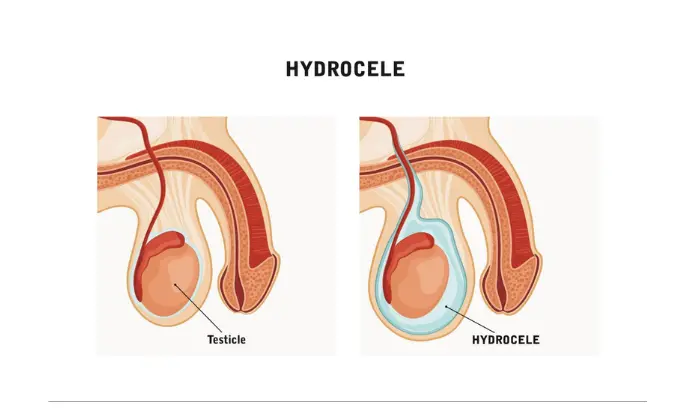
Each testis sits inside a thin sac with two layers. Normally, the space between these layers holds only a few drops of fluid. In a hydrocele, more fluid collects than the body can absorb, and the sac fills and swells.
| Type | What happens | Who it affects |
|---|---|---|
| Non-communicating hydrocele | Fluid collects in a closed sac around the testis | Adult men; the most common type |
| Communicating hydrocele | An open channel to the abdomen lets fluid move in and out, so the size changes through the day | Babies and children; sometimes adults |
| Secondary hydrocele | Fluid forms because of another problem, such as infection, injury or a tumour | Any age |
What Causes a Hydrocele?
| Cause | Notes |
|---|---|
| No clear cause (primary) | The most common situation in adult men |
| Infection or inflammation | Infection of the testis or epididymis can trigger fluid build-up |
| Injury to the scrotum | Trauma can lead to fluid or blood collection |
| Filarial infection | A known cause in parts of India; may cause large or thick-walled hydroceles |
| After hernia or varicocele surgery | Occasionally develops after groin or scrotal operations |
| Testicular tumour | Rare, but an important reason why every hydrocele needs an ultrasound |
| Open channel from birth | Causes communicating hydroceles in babies and children |
Symptoms of a Hydrocele
- A smooth, painless swelling on one or both sides of the scrotum
- A feeling of heaviness or dragging in the scrotum
- Discomfort while walking, sitting or during physical activity
- Difficulty wearing fitted clothes
- Swelling that grows slowly over months or years
- In communicating hydroceles, swelling that is smaller in the morning and larger by evening
When to see a doctor promptly: Pain, redness, fever, a sudden increase in size, or a hard lump you can feel in the testis are not typical of a simple hydrocele. These need evaluation without delay.
Hydrocele or Something Else?
Not every scrotal swelling is a hydrocele. A urologist examines you and confirms the cause with an ultrasound.
| Condition | How it usually differs |
|---|---|
| Hydrocele | Smooth, painless swelling around the testis; light shines through it |
| Inguinal hernia | Swelling extends from the groin, increases on coughing or standing, and may go back when lying down |
| Varicocele | Feels like a “bag of worms” above the testis due to enlarged veins; dull ache after standing |
| Epididymal cyst or spermatocele | A separate small lump above or behind the testis |
| Epididymo-orchitis | Painful, warm and tender swelling, often with fever |
| Testicular tumour | A firm or hard lump in the testis itself, usually in younger men |
| Testicular torsion | Sudden, severe pain; a surgical emergency |
How a Hydrocele Is Diagnosed
| Test | What it shows |
|---|---|
| Physical examination | Size, feel and whether the swelling can be separated from the groin |
| Transillumination | A light shone through the scrotum; fluid lets light pass through |
| Scrotal ultrasound | Confirms the fluid, checks the testis for any lump, and rules out hernia |
| Urine test | Checks for infection if there is pain or burning |
| Blood tests | Before surgery, for fitness for anaesthesia |
Hydrocele in Babies and Children
Many newborn boys have a small hydrocele that disappears on its own within the first year or two as the open channel closes.
| Situation | Usual plan |
|---|---|
| Small hydrocele in an infant | Watch and review; most settle by 1 to 2 years |
| Hydrocele that persists after about 2 years | Surgery is usually advised |
| Size that changes or swelling that extends into the groin | Treated like a hernia, as the open channel needs closing |
Treatment Options for Hydrocele
| Option | Who it suits | Notes |
|---|---|---|
| Watchful waiting | Small, painless hydroceles that do not bother you | Regular review; no harm in waiting |
| Aspiration (draining with a needle) | Men unfit for surgery | Fluid usually comes back; risk of infection |
| Aspiration with sclerotherapy | Selected men unfit for surgery | Medicine injected to help the sac stick together; recurrence is still common |
| Hydrocelectomy | Large, growing, uncomfortable or recurrent hydroceles | The standard treatment with lasting results |
Good to know: A hydrocele does not usually affect fertility or testosterone. Surgery is mainly done to relieve discomfort and the effect of the swelling on daily life, and to treat any underlying cause.
What Is Hydrocelectomy?
Hydrocelectomy is a short operation to drain the fluid and treat the sac so the fluid does not collect again.
- Anaesthesia: Spinal or general anaesthesia is given, so the procedure is painless.
- Incision: A small cut is made on the scrotum.
- Draining the fluid: The sac is opened and the fluid is removed.
- Treating the sac: The sac is either turned inside out and stitched behind the testis, folded and stitched, or partly removed, depending on its size and thickness.
- Bleeding control: Careful sealing of small vessels to reduce swelling afterwards.
- Closure: The cut is closed with dissolvable stitches; a small drain is sometimes left for a day.
- Support: A scrotal support or snug underwear is worn to reduce swelling.
The operation usually takes 30 to 60 minutes. In children, the open channel is closed through a small cut in the groin.
Recovery After Hydrocelectomy
| Timeline | What to expect |
|---|---|
| Same day | Walking within a few hours; mild pain controlled with medicines |
| Day 0 to 1 | Discharge for most men |
| Days 3 to 7 | Return to desk work |
| Weeks 1 to 3 | Scrotal swelling and bruising gradually settle; this is normal |
| Weeks 2 to 4 | Return to heavy lifting, gym, sports and sexual activity, if cleared |
| Weeks 4 to 6 | Swelling fully settled in most men |
Tips for a Smooth Recovery
- Wear scrotal support or snug underwear for 1 to 2 weeks
- Use a cold pack wrapped in cloth for 10 to 15 minutes at a time in the first 2 days
- Keep the wound clean and dry; follow advice on bathing
- Avoid heavy lifting, cycling and strenuous exercise until cleared
- Take pain relief and antibiotics as prescribed
Call your doctor if you have: fever, increasing pain, rapidly increasing swelling, redness or discharge from the wound, or difficulty passing urine.
“I recently visited for a surgery (Hydrocelectomy) and had a wonderful experience. Dr. Vishal was extremely helpful and provided excellent guidance throughout the process, and the surgery went well.”
Kiran K., Google review
Risks of Hydrocelectomy
Hydrocelectomy is a common and safe procedure. Most effects are mild and temporary.
| Possible effect | Notes |
|---|---|
| Swelling and bruising | Common; settles over a few weeks |
| Blood collection in the scrotum (haematoma) | Uncommon; small ones settle, larger ones may need draining |
| Wound infection | Uncommon; treated with antibiotics |
| Return of the hydrocele | Uncommon after surgery, more common after aspiration |
| Persistent firmness or swelling | Occasionally takes a few months to fully settle |
| Injury to the testis, epididymis or sperm tube | Rare; relevant to fertility and discussed before surgery |
Frequently Asked Questions About Hydrocele
Is a hydrocele dangerous?
A simple hydrocele is not dangerous and is not cancer. However, an ultrasound is important to rule out other causes of swelling, such as a hernia or, rarely, a testicular tumour.
Can a hydrocele go away without surgery?
In babies, most hydroceles go away on their own within 1 to 2 years. In adults, hydroceles rarely disappear and often grow slowly. Small ones that cause no trouble can simply be watched.
Can medicines cure a hydrocele?
No medicine removes a hydrocele. Medicines are used only to treat an underlying cause, such as infection. Large or troublesome hydroceles need surgery.
Is hydrocele surgery painful?
The operation is done under anaesthesia, so there is no pain during it. Afterwards, mild pain and swelling for a few days are common and are controlled with medicines.
Does a hydrocele affect fertility?
A simple hydrocele usually does not affect fertility or hormone levels. Surgery carries a small risk of injury to structures near the testis, which is why careful technique matters.
Can a hydrocele come back after surgery?
It is uncommon after a properly done hydrocelectomy. Recurrence is much more common after needle aspiration alone.
When can I return to work after hydrocele surgery?
Most men return to desk work in 3 to 7 days. Heavy physical work, sports and sexual activity are usually resumed after 2 to 4 weeks.
Is hydrocele surgery covered by insurance?
Yes, hydrocelectomy is generally covered by health insurance in India, subject to policy terms and waiting periods. The hospital’s insurance desk helps with cashless approval.
The Bottom Line
A hydrocele is a common, harmless cause of scrotal swelling, but it should still be checked with an ultrasound to confirm the cause. Small hydroceles can be watched, while large or uncomfortable ones are treated with hydrocelectomy, a short operation with a quick recovery and lasting results.
If you have noticed a swelling in the scrotum, Dr. Vishal Shet can examine you, confirm the cause and explain whether watching or surgery is right for you. Consultations are available at Aveksha Hospital (MS Palya), Gurushree Hospital (Chandra Layout), Fortis Hospital (Nagarbhavi) and Hosmat Hospital (Magrath Road).
Related reading: Urological Cancer Treatment in Bangalore | Reconstructive Urology in Bangalore | Prostate Treatment in Bangalore
Medically reviewed by Dr. Vishal Shet, MBBS, MS (General Surgery), M.Ch (Urology) · Karnataka Medical Council Reg. No. 83367 · Last reviewed: November 2026. For general patient education; read our Editorial Policy and Medical Disclaimer.